
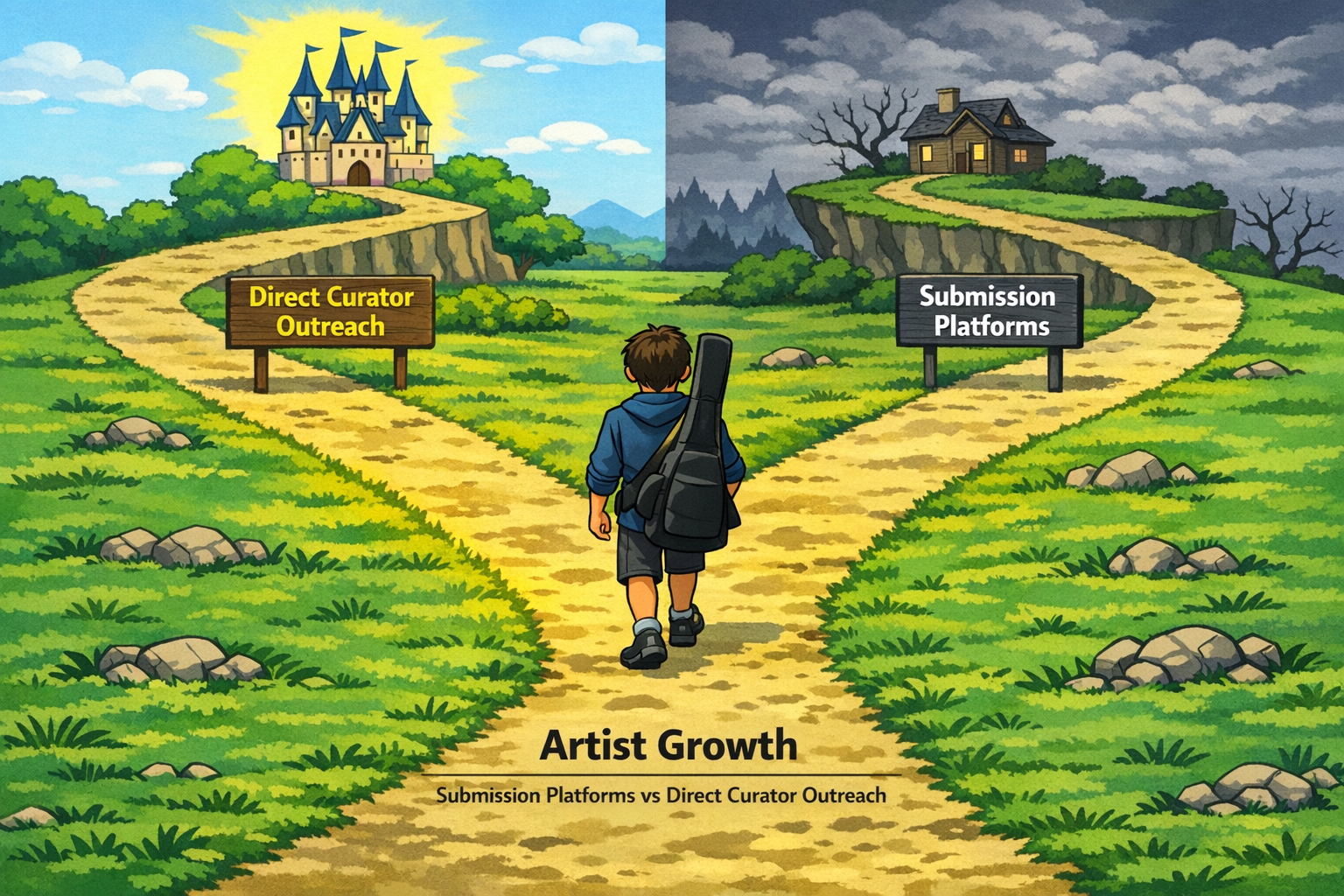
What options are there for artists?
As both a music maker, and a music promotor, I know very well how much work it takes to get your song on Spotify. If you’re an independent artist, still building up your network of like-minded people, it could be true that you do songwriting, recording, mixing, mastering, cover art creation, song promotion and much more, all by yourself. The truth is that having a community of people around you that can help out with some of these difficult, or time-consuming elements is a key characteristic of successful artists. So that you can keep doing what you’re great at. There is one element where we put your attention towards today, as an option to make your life easier: direct curator outreach compared to submission platforms.
On the surface, submission platforms seem like a very good option to new artists: They are easy to use, a lot of curators can be contacted with a click of your mouse, and it is often a fast process to receive some feedback. Underneath that convenience, there are some hard truths: You’re not building any long-term relationships. You’re competing with hundreds of other artists per curator. And most importantly, a large chunk of your budget never even reaches the curator as these intermediary platforms often take significant fees (usually over 50%). What this ultimately means is that playlist curators have a more limited budget to advertise their playlists, which means that the playlists that you are pitching to acquire less new listeners for your music. For the artists that are not accepted into over 40 percent of the playlists that they pitch to, it can feel like throwing money into a system that isn’t built for your success.
Is there a system that works better for curators?
This question comes down to why we started a community of independent curators. At Playlistsforyou, we have removed the intermediary party from the game. This means we can fully focus on bringing new listeners to your music. There are a few reasons why this works so well, and advertising budget is only one of them.
- Every euro you spend goes directly to the curator you work with. With no middlemen fees, curators can invest more into the playlists that you are added in.
- Independent curators know their type of artist, and their listeners, and know when they match. Instead of intermediary submission platforms sending your song to the wrong playlists, or you making wrong guesses, direct curator outreach puts your budget to work at the right places.
- The real advantage; When you connect directly with curators, and work longer together, you’re no longer just another submission. You can start to build ongoing collaborations, where curators get invested in your success. We not only know the ins- and outs of your music, we grow together and your growth is vital to our succes. Curators also rely on repeat collaborations, meaning that now, they need you to succeed to keep collaborating. In some cases, these long-term partnerships have also allowed for closer collaboration such as creating personalised playlists for your specific music style and doing all that we can to find your niche. Independent curator outreach is the basis for building a long-term partnership based on mutual growth.
Is direct curator outreach always better?
Not necessarily. If your track has a high acceptance rate (over 40%) into playlists on submission platforms, these platforms can still be efficient for scalability as you can submit to many more curators at the same time. But for the vast majority of artists, that’s not the reality. Oftentimes, there is a specific audience for your music out there that requires a more personalised approach. One that’s aligned with your growth, not just platform profits. If you’re serious about building momentum on Spotify, stop thinking in terms of one-off submissions. Start thinking in terms of people, partnerships, and long-term results. In today’s music landscape, growth doesn’t come from being seen once, but from embedding yourself in a community where curators and artists are able to lift each other up and move forward together.
Different approaches can work, know that:
1. Intermediary platforms take large fees, meaning curators invest into their engagement.
2. Independent curator networks know their playlists better, leading to less song-mismatches.
3. Direct curator outreach is more personal & leads to stronger long-term collaborations.
4. For artists with (very) high acceptance rates (over 40%) submission platforms are more efficient due to scalability